

[ad_1]
India’s unusually hot summer has killed more than 200 people and sickened thousands more. Amid these extreme weather conditions, there are concerns about the country’s marginalised people.
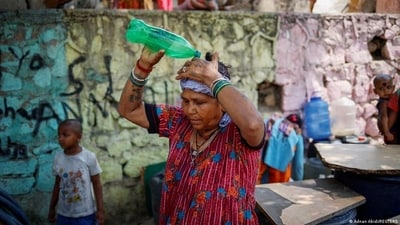
A nationwide heat wave that began in May has brought unprecedented temperatures to northern and western India.
The India Meteorological Department issued a red alert in late May, warning that there was a “high probability” that many people could suffer heat-related illnesses and heat stroke, and urging “extreme care” for vulnerable individuals.
Also read: Can heatwaves be deadly? 5 ways extreme heat can put your life at risk; Dos and Don’ts
However, despite the scorching heat, Kanchan Devi is forced to make a living by baking bricks in the open in the state of Haryana.
Temperature warnings are of little use to informal workers like Devi. This 20-year-old girl has only a cloth wrapped around her head to protect herself from the sun.
Devi, who comes from the Dalit community – a historically marginalized group from the lowest level of India’s centuries-old discriminatory caste hierarchy – sits for hours working at the kiln to make bricks. Last month, Devi experienced dizziness at work during the heat and was later hospitalized due to low blood pressure.
Also read: Scorching heat in Delhi: These 5 problems can happen to the body if the temperature goes above 45 degrees
‘ride to Hell’
A report by the Centre for Labour Research and Action found that more than 50% of the workers at 21 brick kilns surveyed were Dalits.
Raheb Rajput, a Dalit construction worker in New Delhi, told DW that his cousin died in May due to extreme heat. “Our lives are always in danger,” he said. “The heat is increasing with each passing year.”
Nearly 25,000 people have suffered heatstroke during India’s summer season, which runs from March to May, news website The Print reported, citing government data.
National Alliance of People’s Movements, a civil rights organisation, has demanded that this year’s severe heat wave be declared a disaster under India’s Disaster Management Act, 2005.
Is caste a factor in heat sensitivity in India?
Several studies and media reports have highlighted the plight of unorganised sector workers, who form a large part of the Indian labour force, especially during extreme summers – but caste has rarely been identified as a factor contributing to heat vulnerability.
Experts say socio-economic factors can influence people’s sensitivity to heat. A study by the European Trade Union Institute (ETUI) found that occupational heat exposure increases social inequalities.
“Research shows that caste-based division of labour still persists in India’s modern market economy,” said Arpit Shah, a professor at the Indian Institute of Management in Bengaluru, one of India’s most populous cities.
Shah’s ongoing research explores the relationship between race and occupational heat exposure.
“Construction workers and sanitation workers disproportionately belong to marginalised caste groups. Since these occupations involve more outdoor work, they are more vulnerable to heat waves,” Shah said.
According to some reports, 90% of the workforce in India is employed in the informal sector. According to a 2020 report by the National Campaign on Dalit Human Rights, a large proportion of workers in the informal sector belong to the Dalit community, Scheduled Tribes, and other “low” caste groups.
Challenges faced by brick kiln workers
Most of the workers in the brick kilns are migrants, who live in shanties where bricks are stacked one above the other, with tin sheets or tarpaulins used for roofing.
Sometimes, migrant workers along with their families, including children, live at the kiln in the extreme heat.
Devi said she sleeps in the fields at night. “It is very hot inside our tin-roofed hut,” she said.
Most slums lack basic amenities like fans and bulbs. Many workers DW spoke to said they had arranged for fans on their own.
Some employers do not even provide drinking water. Workers have to look for water in the surrounding areas and this shortage also puts them at risk.
People’s personal environments can make them more likely to be sensitive to heat, said Gulrez Shah Azhar, a former researcher at the Public Health Foundation of India.
“Imagine living in a slum,” he said. “There is no separate bathroom or running water supply to have privacy to take a shower. All of these factors increase how sensitive a person is to the heat.”
As the mercury rises, coolness and availability of shade become a key strategy for adapting to the heat, but most of the Dalit community people DW spoke to did not have air coolers – let alone air conditioners.
Lower caste and tribal families also get 10%-30% less access to electricity.
The path to inclusive policy to tackle heat waves
The National Disaster Management Authority adopted the UN Sendai Framework for Disaster Risk Reduction and released its plan in 2016. The initial plan considered only the elderly and the disabled as vulnerable groups to natural disasters. However, it was revised in 2019 to include Scheduled Castes and Scheduled Tribes in this category.
“The heat action plans prepared at the state, city and district levels do not take into account the impact on vulnerable caste groups,” said Bina Johnson, general secretary of the National Campaign on Dalit Human Rights.
A study by the Delhi-based think tank Centre for Policy Research found that “almost all heat action schemes are poor at identifying and targeting vulnerable groups.”
Mukul Sharma, author of the book “Caste and Nature”, said the government has provided data only on heat-related deaths but a disaggregation of the data would reveal that most of the victims are Dalits.
“We are all living in a different time. Heat is the biggest inequality issue of our time,” Azhar said.
[ad_2]

