

[ad_1]
France is working on a new law to better regulate fast-fashion companies. Experts and activists welcome the measure – although some would have preferred a different approach. France’s fast-fashion bill was recently passed unanimously in the lower house of parliament, creating a rare unanimity in the National Assembly, where the government does not have an absolute majority and often faces stiff opposition.
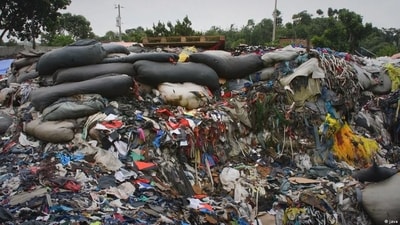
But that consensus doesn’t mean everyone welcomes the government’s method. The new rules will affect companies that offer a certain minimum number of products per day – a limit that will be defined later by decree. The government is targeting fast-fashion giants such as China-based manufacturer Shein and online platform Teemu.
Such companies must post clearly visible messages on their websites highlighting the environmental impact of their products and exhorting customers to recycle items – otherwise they face fines of up to €15,000 ($16,160). A new eco-point system will evaluate fashion companies. Poor performers will have to pay a levy initially of €5 and then up to €10 per item by 2030.
And the government will ban the promotion of fast-fashion companies and their products from 2025. Violating that law would result in fines of up to €100,000. The bill still needs to be given the green light by the French Senate and could come into force in the coming months.
‘We have won the cultural battle’
However, for Julia Faure, a fashion designer and president of the group En Mode Climate, which includes about 600 companies that produce fashion in a sustainable way, the draft law is already “big news”. “We have won a cultural battle, because fast fashion is an environmental, social and cultural disaster that wipes out everything except the luxury sector in the market like a giant juggernaut,” he told DW.
Faure thinks the government is sending the right signal when fashion made from cotton and produced locally gets a good eco-score, while products manufactured far away and synthetic fabrics get poor ratings. “And yet, we need to be cautious and ensure that the threshold through which fast-fashion companies are defined is not set too high,” he said.
But Philippe Moati believes that the limit should not be too low, to ensure that French brands are not included in it. He is a professor of economics at Paris Cite University and the founder of Obsco, a Paris-based market research company.
correct way?
And he disagrees with the way the government is doing. “The draft law stigmatizes the customers of these brands, who, according to a study we’re conducting, are less educated and less affluent,” he told DW. “It’s important for them to be able to afford fashion so they can feel comfortable.” So that they can feel that they are part of the society.” , The economist estimates that what he calls “ultra-fast fashion” accounts for about 3% of France’s fashion market – exact figures do not exist.
Moaati advocates that fast-fashion businesses should be more strictly regulated, but with existing tools. “The government should enforce French laws such as a two-year guarantee for fashion goods, a ban on selling below cost and an obligation to calculate discounts using realistic reference prices,” Moati said.
“Furthermore, we should impose import duties on all textile imports – not just those that currently cost at least €150,” the expert urged, adding that the advantage of ultra-fast fashion was that it made it easier for products to be imported. A very small series has been prepared. This also meant that practically no item remained unsold. Shein, Teemu, Zara and H&M either declined or failed to respond to requests for interviews with DW.
France can lead this
Gildas Minviel, director of the economic observatory at the Paris-based fashion school Institut Français de la Mode, believes time will tell whether the government’s approach is the right one. “This is uncharted territory – we need to test what works and what doesn’t,” he told DW. “However, in any case, it is important to remind consumers of the devastating impact fast fashion has on the environment.”
For him, the unanimous vote in parliament shows that French politicians have understood that action is urgently needed. “The draft law is a response to the deep crisis facing the pret-a-porter sector [designer clothes sold ready-to-wear] Many brands are filing for bankruptcy by 2022,” he said.
“France, the home of fashion, can now lead the way. These rules should be implemented across Europe because the fashion market is a European market,” he said. There were some dissenting voices in the National Assembly such as Antoine Vermorel-Marx, an MP for the Loire department in central France for the conservative party Les Republicains.
“Fashion companies in my home county employed about 10,000 people in the 1980s, but that number has dropped to 2,000 after outsourcing production to Asia,” he told DW. “Recently they have begun to hire workers again,” said Vermorel-Marx, as the trend to buy locally produced goods has increased. Fast fashion has now created new pressure on costs – us “Countermeasures need to be taken.”
And yet, politicians do not welcome all the paragraphs of the draft bill. “Restrictions on advertising would disrupt the market rather than regulate it. We should only focus on eco-points systems that would allow us to take into account negative externalities, i.e. holding companies responsible for the negative environmental and social impact of their products. Will have to pay.” ” he underlined.
‘More measures needed’ for climate goals
But Pierre Condamine, spokesman for the group Stop Fast Fashion, which includes several NGOs fighting to protect the environment, thinks the new rules don’t go far enough. “The threshold defining fast fashion should be included directly in the bill and should be low enough to include even French companies like sporting goods retailer Decathlon,” he told DW. “If companies get a negative eco-score, they will have to pay a minimum levy, which is not included in the plans so far.”
He said fast-fashion companies should have an obligation to publish their sales figures for France. “This is the only way we can really understand what we are facing and try to work towards meeting the Paris climate agreement,” Condamine said, urging French citizens to “make every year Buy no more than five new fashion items – and no more than 50 currently, just in case.
[ad_2]

