

[ad_1]
Easy availability and access to technology has been a major driver of human progress in the 21st century. One of the biggest benefits of this has been that information is readily available at the fingertips of man. However, this benefit is neither evenly distributed nor available. While mankind in general has been able to use technology to access outer space and prepare for a variety of disaster scenarios, division of technology and knowledge across countries and regions within geographic areas is also a reality. The consequences of the climate crisis pose the greatest challenge to the continuation of human existence. While much progress has been made in accurately predicting impending natural disasters, the skills, expertise and technology remain far beyond the grasp of developing countries in particular.
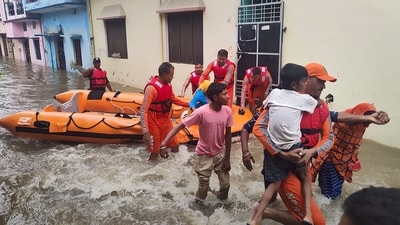
2024 alone has seen some unprecedented natural disasters driven by the climate crisis. Dubai, Oman, Bahrain and Qatar witnessed unprecedented flooding, while southern China was devastated by deadly floods. California was hit by wildfires, while an earthquake measuring 7.4 on the Richter scale struck Taiwan, causing massive loss of life and property. In May, torrential rains hit the island of Sumatra in western Indonesia, leading to severe flooding, which was triggered by the cooling lava flowing from Mount Marapi volcano, located on the west side of the island.
While the damage is enormous in each of the myriad cases, specific case studies of geographically and spatially disadvantaged countries become important. In this context, it becomes crucial to take a closer look at how Taiwan is using data and technology-based information. Taiwan is an island nation with a population of 23.57 million, located in the Western Pacific between Japan and the Philippines. Taiwan lies in a seismically active region on the Pacific Ring of Fire. Geologists have identified 42 active faults on the island. Most of the earthquakes that occur in Taiwan are caused by the convergence of the Philippine Sea Plate and the Eurasian Plate to the east of the island.
Climate change has caused temperatures in Taiwan to rise by 1.4 degrees Celsius over the past 100 years. Sea levels around Taiwan are projected to rise at twice the rate of global sea levels. Tsunamis, floods, and earthquakes are the biggest and most common threats to Taiwan. Between 1901 and 2000, Taiwan has been hit by 91 major earthquakes, 48 of which resulted in loss of life. To address the challenge, the Taiwanese government has an earthquake app, which sends early warnings, earthquake reports, and tsunami updates. The app is copyright of the government’s Central Meteorological Administration. What makes the app effective is the easy availability of data on the population density of particular areas, quick communication between various government departments and mobile service providers. The mapping of sub-regions of counties and the easy availability of forms of human settlements within them not only makes it easier to understand how high the potential damage could be, but also helps in better preparation. Easy availability of data on livelihoods and living patterns followed in the sub-regions can also help in assessing the potential damage, and prepare necessary evacuation and relief structures in case of natural disasters.
Another example from Taiwan that is worth mentioning in this context is the Taiwan Cooperative Rainfall Group Forecasting Experiment or TAPEX. Early warnings with sufficient time to forecast floods can help people prepare for disaster scenarios. To provide such warnings, a statistics-based flood forecasting model was developed in Taiwan to evaluate the probability of flooding in urban areas using group quantitative rainfall forecasts. Indices such as designed capacities of storm sewer systems, flood inundation potential databases, and historical observations of floods helped evaluate the probability of flash flooding situations. The Taiwan Typhoon and Flood Research Institute initiated TAPEX in 2010.
Taiwan’s level of economic development is different from most other countries in the Indo-Pacific region. However, some natural disasters like the floods in Taiwan have been the bane of others as well. Guwahati in India, which is planned to become a smart city, is currently reeling under severe floods. One area of scientific collaboration between India and Taiwan under the aegis of India’s Act East policy and Taiwan’s new Southbound policy could be to understand how to use technology to better prepare for floods. However, to reach that level and successfully use technologies, there will be a need to collect extensive data on population, nature of habitats, historical flood patterns, active sewer systems, etc. The availability of such data not only helps the government to prepare better but also helps civil society to understand their options in the worst but frequently occurring scenarios of natural disasters.
This article is written by Shriparna Pathak, Associate Professor, Chinese Studies and International Relations, Jindal School of International Affairs, OP Jindal Global University, Sonipat.
[ad_2]

