

[ad_1]
In 2024, the number of cars in the world is set to increase to 1.475 billion – that’s one car for every 5.5 people or 182 cars for every 1,000 people. These numbers may seem huge until you hear what they do to the planet – a typical passenger vehicle emits about 4.6 metric tons of carbon dioxide per year (source: US Environmental Protection Agency). Multiply that 4.6 metric tons by 1.475 billion cars and the picture becomes dire.
What if we didn’t have cars and could live without traffic jams and honking horns? It might seem like an impossible dream now, but some cities around the world have chosen to live car-free every day.
On World Car-Free Day, let’s take a tour of some car-free cities:
Zermatt (Switzerland): Nestled at the foot of the Matterhorn, one of the most photographed mountains in the world, Zermatt has always been car-free. Private vehicles are allowed up to Täsch (5 kilometers from Zermatt). In Täsch, one changes to a shuttle train and travels to Zermatt (the train runs every 20 minutes). You can get around on foot, by horse carriage, by e-taxi, by bike or mountain bike or by free e-bus (2 routes: Skibus and Winkelmatten bus).
La Digue Island (Seychelles): La Digue, a tiny dot in the Seychelles archipelago barely 45 minutes from the capital, Mahe, is an island where no one is in a hurry. No traffic jams. No honking horns. Get on a bike and take a leisurely ride on the main road that circles the island. Stop at Anse Source d’Argent, renowned as one of the most photographed beaches in the world. Trek to Anse Coco, get a snorkel or a see-through kayak to watch the fish. And if you want to make some slow-moving friends, stop at La Union Estate to feed the giant tortoises, tasting coconut wine while you’re there! For those who don’t like to walk or have limited mobility, some electric buggies are available as an option.
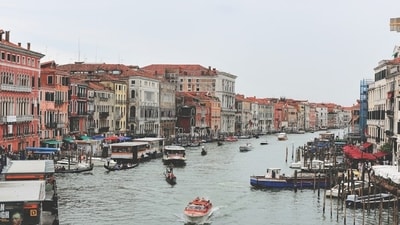
Venice, Italy): Venice’s Centro Storico is often described as Europe’s largest pedestrian-only urban space. Built on a cluster of 126 islands, Venice has over 400 stepped bridges over canals to connect each district. A UNESCO World Heritage Site that attracts 20 million tourists each year, Venice is vehicle-free. Venice once even planned to ban rolling suitcases! They dislike wheels of any kind so much.
Lamu (Kenya): One of the oldest continually inhabited Swahili towns, cars are banned in Lamu. There are donkeys for land transport and dhows for traveling around the archipelago. Now a UNESCO World Heritage Site, in the 1960s, hippies called Lamu the Kathmandu of Africa. Built of coral stone and mangrove wood, Lamu’s old town is characterized by narrow streets and magnificent stone buildings with impressive curved doorways, influenced by a unique blend of Swahili, Arabic, Persian, Indian and European building styles.
Fes el Bali (Morocco): Fes-el-Bali, the larger of Fes’s two medinas, is a nearly intact medieval city. With 13,380 historic buildings, the entire medina was designated a UNESCO World Heritage Site in 1981 and is possibly the world’s largest contiguous car-free zone. Some of Fes’ streets are as narrow as 24 inches and very few touch the 16-foot width mark. The streets are generally too narrow for bicycles to use, although there are some areas where bicycles and motor scooters can be found.
Ghent (Belgium): The city center of Ghent, a university town famous for its medieval architecture and row of guildhalls, has been car-free since 2017. Ghent has a free park-and-ride shuttle. In addition, regular city bus routes, tram lines and even an electric boat ensure eco-friendly mobility. Night buses and free transport for children up to the age of 14 make local public transport even more attractive.
Hydra (Greece): If you plan to visit the mountainous island of Hydra, leave your car – even bicycles – behind. Not only are cars free on the island, bicycles are also banned. So, what do you think of the labyrinth of streets? Walk, of course. But if your knees shake, get on the back of the island’s mules. Mules may be slow, but you’ll get used to their slow pace. Boats are best for remote beaches.
Giethoorn (Netherlands): Barely 75 miles from Amsterdam, Giethoorn has no cars. It doesn’t even have paved roads. Known as the Dutch Venice, this postcard-perfect village can be explored by bike, boat or on foot through a maze of canals. The story goes that the town got its name when its original farmer-inhabitants discovered a collection of horns from wild goats that they believed had died in the flood of 1170. Giethornen (goat’s horns) later became Giethoorn.
Yelapa (Mexico): Literally where two rivers meet the ocean, Yelapa is nestled in the southernmost bay of Banderas Bay, the world’s seventh largest bay. There are no cars in Yelapa, although there is a road that leads to the outskirts of the village. The most widely used method of getting to and from the pueblo is by boat. In the 1960s and ’70s, hippies would hang out in open-air houses called palapas. “I’d rather have a palapa in Yelapa than a condo in Redondo” is still a common T-shirt slogan.
Good to know: To learn more about the car-free movement around the world, visit the World Carfree Network, the hub of the global car-free movement. Read their e-magazine Carbusters online.
[ad_2]

