

[ad_1]
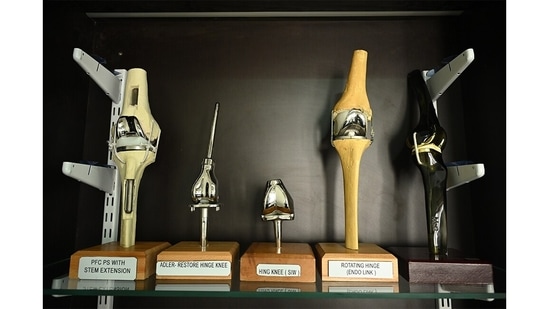
Knee replacement, also known as knee arthroplasty, is a surgical procedure to replace worn out weight bearing knee joints, where during surgery, damaged bones and cartilage are replaced with metal and polyethylene. Knee replacement is performed by conventional method and robotic arm assisted technique.

Robotic Assisted Knee Replacement
In an interview with HT Lifestyle, Dr Srikanth Madikattu, orthopaedics consultant at Manipal Hospital in Baner, Pune, explained that robotic knee replacement is a relatively new technique and said, “Robotic arm assisted total knee replacement currently has some advantages over conventional surgery, although both techniques are effective for arthritis of the knee joint. Short-term studies have shown no significant difference between conventional and robotic total knee replacement in patient outcome, including pain and quality of life. Long-term studies of robotic assisted knee replacement are yet to come.” He added –
Benefit:
- Increasing accuracy and precision in surgery
- improving implant alignment and position
- minimal soft tissue release
Shortcoming:
- High cost and limited access to technology
- Potential technical issues and dependence on technology
- Limited evidence to support long-term outcomes
Traditional Total Knee Replacement
Dr. Srikanth Madikattu revealed –
Benefit:
- These have been performed for several decades, with long term data available
- They are less expensive than robotic knee replacement
- These can be executed in less time
Shortcoming:
- The operation cannot be performed in a patient with severe extra-articular deformity and implants around the knee joint
- A more gentle release is needed depending on the knee deformity
Sharing his expertise, Dr Sujoy Bhattacharjee, HOD and Director, Robotic Joint Replacement, Sarvodaya Hospital, Faridabad said, “As a robotic joint replacement surgeon, I have witnessed first-hand the transformative impact that robotic-assisted surgery has had on the field of orthopedics. While traditional joint replacement techniques have served patients well for decades, robotic technology offers several distinct advantages that can improve outcomes and enhance the patient experience.” He elaborated –
Precision and Accuracy
The most important advantage of robotic joint replacement is that it offers unmatched accuracy and precision. The robotic arm, guided by advanced software, allows surgeons to plan and execute the procedure with meticulous care. This level of precision is especially important when dealing with complex cases or when preserving bone and soft tissue is a priority.
advanced soft tissue protection
Robotic surgery enables surgeons to perform more delicate procedures, minimizing trauma to soft tissues. This is important because maintaining the integrity of soft tissues speeds up healing time, reduces pain, and improves long-term function. In contrast, traditional techniques can sometimes involve more invasive dissection, potentially increasing postoperative discomfort and complications.
Increased flexibility
Robotic-assisted surgery offers greater flexibility than traditional techniques. The robotic arm can be positioned at a variety of angles and directions, allowing surgeons to reach difficult areas and perform complex tasks with ease. This flexibility can be particularly beneficial in cases where the anatomy is abnormal or when previous surgery has altered the structure of the joint.
better patient outcomes
The combination of precision, soft tissue preservation, and flexibility offered by robotic joint replacement has led to improved patient outcomes. Studies have shown that patients undergoing robotic-assisted joint replacement may experience faster recovery, less pain, and better overall function than those undergoing traditional procedures. Additionally, the lower risk of complications associated with robotic surgery may contribute to improved patient satisfaction.
At the same time, it is important to recognize that robotic surgery is a tool, not a substitute for a skilled surgeon. While the technology can enhance accuracy and precision, it is ultimately the surgeon’s expertise and judgment that determines the success of the procedure.
The future of joint replacement
As robotic technology continues to evolve, we can expect to see even more advancements in the field of joint replacement. Future innovations may include better software algorithms, advanced haptic feedback, and even the integration of artificial intelligence. These developments have the potential to further refine the surgical procedure and improve patient outcomes.
In conclusion, robotic joint replacement represents a significant advancement in the field of orthopedics. By offering increased precision, soft tissue preservation, and flexibility, robotic surgery can improve patient outcomes and enhance the overall experience of joint replacement surgery. As robotic technology continues to develop, it is likely to play an important role in the future of joint replacement.
Disclaimer: This article is for informational purposes only and is not a substitute for professional medical advice. Always seek the advice of your doctor for any questions about any medical condition.
[ad_2]
