

[ad_1]
Counseling for postgraduate medical admissions will now be done only in online mode and colleges will have to declare the fees for each course in advance, the National Medical Commission (NMC) has said, underlining that no college can admit candidates on its own. Will not give. Also read: NEET-PG 2024 likely to be held in June-July, if delayed, counseling in August: Sources
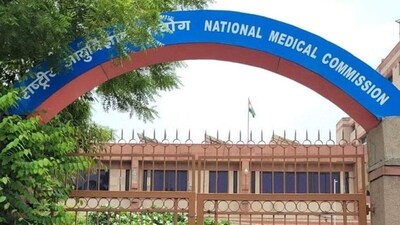
Medical education regulator NMC has recently notified “Postgraduate Medical Education Regulations, 2023” according to which all rounds of counseling for all PG seats will be conducted on online mode by the state or central counseling authorities.
The new rules state that common counseling for admission to postgraduate courses in medicine for all medical institutions in India will be based only on the merit list of the respective examinations.
“All rounds of counseling for all seats will be conducted by the state or central counseling authority on online mode and no medical college/institution will grant admission to any candidate,” it said.
“While entering details in the seat matrix, medical colleges must mention the amount of fees for each course, failing which the seat will not be counted,” the rules state.
Dr Vijay Ojha, chairman of the NMC’s Post-Graduate Medical Education Board, said some changes have also been introduced in the examination system including the option of formative assessment and multiple choice questions in university examinations.
“This is to bring fairness in the examination and match international standards,” he said.
Another change has been made in the District Residency Program (DRP) to facilitate its implementation for better training of students.
Earlier, a district hospital was defined as a hospital with 100 beds. Dr. Ojha said that in the new rules the requirement has been reduced to 50 beds.
“Under the DRP, doctors can be trained in the district hospital, which will be a functional public sector/government funded hospital of 50 beds instead of the previous requirement of 100 beds,” the rules said.
DRP aims to train postgraduate students in district health systems and hospitals to strengthen health services at the grassroots level.
According to the new rules, once a medical college gets permission to start PG courses or seats, the course will be considered recognized for the purpose of qualifying registration for students.
Dr Ojha said, this will solve many of the difficulties faced by students in registering their degrees after passing the postgraduate examination.
According to the new rules, undergraduate medical colleges can now start postgraduate courses from the third year. Earlier it was from the fourth year in clinical specialties.
Existing or proposed non-teaching hospitals owned and managed by the government can start postgraduate courses without undergraduate colleges. Dr. Ojha said, this will facilitate the government to start post graduate medical colleges in small government hospitals/district hospitals.
There will be a minimum standard requirement document which will determine the requirement of infrastructure and faculty clinical material etc. for the postgraduate institution.
All students must undergo courses in research methodology, ethics and cardiovascular life support skills.
“For better implementation of these rules, there is a provision for penalty clause which includes monetary penalty, reduction in the number of seats (admission capacity) or complete ban on admission,” the rules state.
[ad_2]

