

[ad_1]
After the detection of H5N1 bird flu in dairy farms, researchers confirmed that the respiratory virus has spread to other animals. There is still a low risk to humans. Researchers have investigated the spread of H5N1, a contagious and highly pathogenic avian influenza (HPAI), in nine farms in the US states of Texas, New Mexico, Kansas and Ohio – and found that “epidemiological and genomic data revealed a dominant cow-to-cow transmission pattern.”
In a study hastily released by the journal Nature on July 25 after preliminary review, researchers reported an “outbreak of HPAI H5N1 virus in a herd of dairy cattle […].” They were also able to trace transmissions from cattle to cats and from cattle to raccoons, demonstrating, as they said, “the ability of the virus to cross species barriers.” Their evidence showed that the mammary gland in cattle “is the main site of virus replication, resulting in substantial virus excretion in milk.” Some infected cows produced discolored and/or curdled milk.
The researchers wrote that “the risk of human-to-human transmission is low,” but “continued and widespread spread” of the virus “poses a major threat to animal and public health.” In May 2024, DW reported that US health officials confirmed that HPAI H5N1 was spreading among dairy cattle in nine US states. The virus was found in raw milk from infected cows, including some milk samples sold in grocery stores.
US health agencies said pasteurized milk products are safe because the pasteurization process kills the virus. They advised against consuming raw milk products.
H5N1 bird flu adapted to spread to other animals
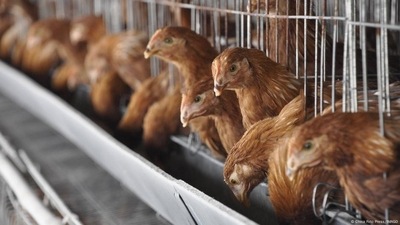
The H5N1 virus has adapted to infect mainly birds, but outbreaks in wild birds have been common in the past two decades. Sporadic outbreaks have occurred in poultry farms around the world, including the United States and Europe, since 2022. Outbreaks in cows and other mammals, including foxes, bears, and domesticated mink, cats, and dogs, show that it is possible for H5N1 to adapt to and transmit in other species.
“Since the year 2022, the H5N1 virus has been spreading particularly rapidly and is also spreading to other animals. Every time it spreads to a mammal, it gives the virus an opportunity to adapt and transmit between animal species,” Andrew Pekosz, an immunologist at the Johns Hopkins Bloomberg School of Public Health in the US, said in a media briefing on May 15.
Can humans get H5N1 bird flu?
The U.S. Centers for Disease Control and Prevention (CDC) said in an update on May 14 that there is no strong evidence that bird flu is spreading to people. It also said the current public health risk is low. Spread of H5N1 from an infected person to close contacts is also rare, because the virus has not adapted to replicate inside human cells. Whenever infections in humans have occurred since the virus was first identified in 1997, the virus has not spread to many people. Since then, fewer than 1,000 human cases of Asian HPAI H5N1 have been reported worldwide.
Two people have been confirmed to be infected with the H5N1 virus in the current outbreak in the US. The first case was in 2022, while the second case was confirmed in April 2024 after exposure to dairy cattle that were possibly infected with bird flu. “The current risk to humans is highest for people who are in occupational contact with susceptible animals. This would include people who work on farms (livestock, pigs, poultry, etc.) and with wild animals,” said immunologist Matthew Miller of McMaster University in Canada.
How does bird flu spread?
Scientists believe the virus is spread in a variety of ways, including through the birds’ saliva, mucus or feces. “It seems likely that contaminated milking equipment is the source, since the virus is found to be very high in udders and milk – but other routes of transmission are also possible,” Miller told DW via email. Transmission of the virus between cows could also lead to it spreading to humans, but so far there is no evidence that this has happened.
“Every time a human is infected, the virus has a ‘lottery ticket’ that gives it a chance to ‘learn’ how to spread efficiently among humans. So, really strong measures should be taken to protect people with high occupational exposure,” Miller said.
Is there a vaccine available for H5N1?
Vaccines are available for H5N1 viruses. Vaccination of poultry against H5N1 is widely used in some countries, such as France. Several vaccines have been approved for use in humans. Some governments have stockpiled various influenza vaccines that could be quickly brought into production in the event of an H5N1 outbreak in human communities.
“We have been observing birds for many years. [influenzas] “There is a potential threat for the next pandemic. We are better prepared to react and respond to a potential H5N1 pandemic than we are to COVID-19,” Pekosz said. The CDC advises people to avoid contact with sick or dead animals, including wild birds, poultry and pets. It also advises people to avoid preparing or eating uncooked or undercooked food or related unpasteurized food products, such as unpasteurized (raw) milk.
[ad_2]

