

[ad_1]
Whenever contact lens wearers wear a new pair they create waste: the old pair of contact lenses, the packaging from the new pair, and the saline solution bottle. This all adds up to about a kilogram (2.2 pounds) per year, with reusable contacts producing slightly less. And with 140 million contact-wearers worldwide, that means a lot of crap. (Also read | Is it safe to wear colored contact lenses after LASIK surgery?,
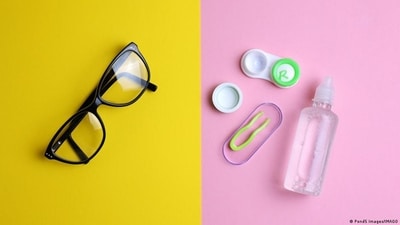
But glasses come with their own problems. It is estimated that almost half of the world’s population will need glasses by 2050, working on what is better for the environment could have a profound impact.
Contact lenses make microplastics
According to Charles Rolsky, about 20% of contact wearers in the United States flush their used lenses down the drain. He is the executive director of the Shaw Institute, an American non-profit that studies how pollutants such as plastic affect the environment and humans.
As part of his PhD thesis, Rolsky looked at the impact of waste from disposable contact lenses and found that 2 to 3 billion plastic lenses end up in wastewater in the US alone.
They followed the contact lenses’ journey through a wastewater treatment plant and saw the plant’s end product, a nutrient-rich fertilizer called biosolids.
A “truly remarkable study” showed that the lenses survive the waste water treatment process. “They’re very porous. So, there’s a possibility that they could be contaminated with things like diseases or other types of chemicals, and they’re also fragmented into microplastics,” he said.
Microplastics are small particles of plastic that easily disperse in the environment, especially in water. They can get into the food chain and eventually get back to humans.
A separate study in 2023 found that at least 18 types of contact lenses sold in the US contained high levels of PFAS, known as forever chemicals. It’s unclear whether PFAS directly affect contact lens wearers, but these toxic chemicals can contaminate soil and water and accumulate in animals before potentially ending up inside humans.
So, are glasses better than contacts?
it’s hard to say. Very few eyewear manufacturers in the $150 billion industry publicly report their carbon impact.
But once in consumers’ hands, the glasses don’t generate much waste other than the occasional cleaning wipe. Environmental impact occurs during large-scale manufacturing.
Lenses are usually made from large pieces of plastic the size of a hockey puck. Up to 90% of that original clump is cut away to make the lenses, according to Andrew Clark, a science communicator who helped set up UK consultancy Net Zero Optics. Making the frames, which are mostly plastic, generates the same amount of waste as the lenses.
The manufacturing of glasses is also problematic due to overproduction, according to Max Jurachek, a scientist at Germany’s Braunschweig Technical University who leads a group researching sustainable factory systems.
“Probably half of them are thrown away before they can be sold, because it takes so long [from manufacture to final sale] And it’s a fashionable product and probably nobody is interested in this particular frame,” he said.
According to Jurashek, glasses are a fashion accessory, with many Americans buying a new pair every year. Like other fast fashion items, frames end up in landfills.
What about recycling glasses and contacts?
Glasses are produced using a complex range of materials, including plastics that are difficult to recycle.
“We are a plastic-heavy industry and much of it is derived from fossil fuels,” Clark said. “We are in an industry that is very international, the bulk of our manufacturing is done in China and the Global East.”
“Every step in that journey is either refining the plastic product or further refining the plastic product. And that adds a substantial carbon footprint very quickly,” he said.
In the UK, there are some programs that claim to recycle both contact lenses and their packaging, as well as glasses. Contact lenses cannot be recycled with other plastic waste because they are too small and cannot be separated.
When it comes to glasses, specialized recycling programs attempt to separate the plastics into their component materials before turning them into low-grade materials that may eventually end up in landfills.
Glass lenses are an alternative to plastic, but they are also difficult to recycle due to the use of special coatings.
What about durable glasses?
Frames are often made from acetate, a mixture of plant-based materials and fossil fuels. But eyeglass manufacturers are now marketing something called bio-acetate. According to Clark, this is simply greenwashing, considering how much plastic is still in it.
He said, “I would compare it to making a burger. You can’t get away with saying ‘Oh, it’s a vegan burger, 75% of it is vegan.'”
So, contacts or lenses?
Being mindful of waste is one of the most impactful decisions glasses or contact lens wearers can make.
Contact wearers should avoid washing lenses down the sink – this only contaminates the environment with waste water and microplastics. And if possible, finding a specialized recycling program can make a difference.
Eyeglass wearers may choose to simply replace their lenses and avoid purchasing new frames merely for fashion’s sake.
Jurachek’s team found that by moving glasses production closer to consumers and using locally recycled materials, the environmental impact of glasses could be reduced by 25%.
Part of this success came from small-scale manufacturing which cut down on overproduction. The team also found that customers had greater engagement with the product because it was local.
[ad_2]

