

[ad_1]
Last updated:
South Korea News: The commander of the US Army stationed in South Korea said that not reacting immediately to any threat in the Korean Peninsula is part of America’s strategy. Under the new national security policy, America is strengthening Seoul and Tokyo instead of direct intervention. The emphasis is on balancing China’s influence through the First Island Chain.
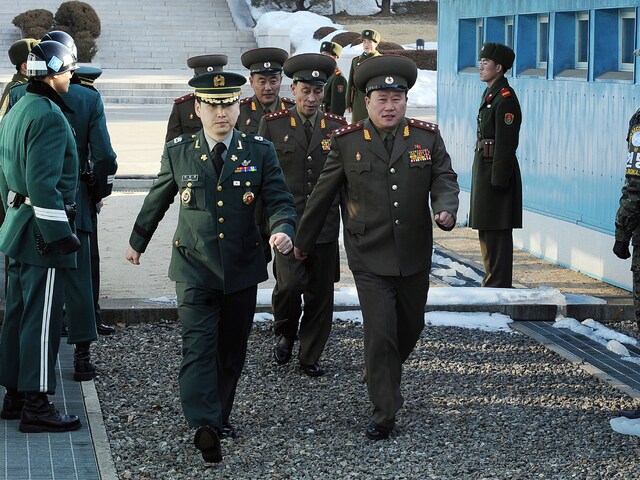 Border between North Korea and South Korea. (Credit-Reuters File)
The commander of the US Army deployed in South Korea on Monday made an important point regarding the strategic role of Seoul. He explained why America does not immediately respond military to any potential threat in the Korean Peninsula. General Xavier Brunson, Commander of US Forces Korea, said that this is because America wants that in the event of any conflict, strategic balance should be maintained first and every step should be taken in collaboration with the allied countries. In a forum organized on the alliance between America and South Korea, Brunson said that this decision is related to America’s new National Security Strategy. Under this, America is working on a policy of strengthening its allies instead of direct intervention. He said that Washington wants Seoul and Tokyo to acquire enough military and strategic capability to face regional threats. Brunson specifically mentioned the ‘First Island Chain’. It is considered an important strategic chain spread across the Pacific Ocean, which includes areas like Japan, Taiwan and the Philippines. America’s strategy is to balance China’s growing military influence by strengthening this chain. South Korea and Japan are considered important parts of this security structure. The commander did not say anything about North Korea.
What did the commander say?
According to the report of Yonhap News Agency, in his address, Brunson said, ‘Recently the US National Security Strategy document was released, which makes us aware of the importance not only of this region but also of Korea itself. It also emphasizes how important like-minded partners play in keeping the Indo-Pacific stable and predictable. He further said, ‘And for that matter, Korea is not just responding to threats on the peninsula. ‘Korea is at the intersection of larger regional dynamics that shape the balance of power across Northeast Asia.’
What did you say about North Korea-Russia cooperation?
Regarding North Korea’s military cooperation with Russia (particularly after North Korea sent troops to help Moscow’s war against Ukraine), Brunson said that Pyongyang has made a ‘long-term strategic decision’. Brunson said North Korea’s “deepening military partnership with Russia, such as arms exchanges for advanced technology,” has advanced the North’s missile and nuclear programs in “dangerous ways.” He further said, ‘And on the other hand you see a government which has taken a long-term strategic decision and has not played any game of temporary bargaining.’
On December 22, South Korean Foreign Minister Cho Hyun said he would work to establish peace on the Korean Peninsula through dialogue with North Korea and other concerned countries, and reiterated the government’s efforts to reconnect with Pyongyang. Cho said at an event organized by the South Korea-US Parliamentary Union that the time had come to “think deeply about what should be done” to ensure security and peace on the peninsula.
[ad_2]

