

[ad_1]
Attention constellation and astronomy buffs! Get ready for the biggest astronomical event of the year: a total solar eclipse to grace the night sky. This eclipse will cross Canada, the United States and Mexico while moving across North America. It is important to remember that despite the excitement, Indians will not be able to see this particular eclipse. However, scientists believe that this type of eclipse is extremely rare. When the Moon comes between the Sun and the Earth, completely blocking the Sun, it is called a total solar eclipse. The sky will become dark, just like at sunrise or sunset. From date to time, here’s everything you need to know about this astronomical event.
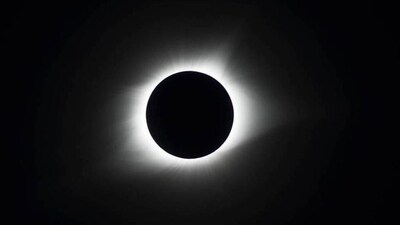
Total Solar Eclipse 2024: Date and Time
The total solar eclipse occurring on Monday, April 8, 2024 will cross North America and pass through Canada, the United States and Mexico. According to NASA, the total eclipse is expected to begin over the South Pacific Ocean. Observers on the path of totality will see the Sun completely obscured by the Moon’s shadow. The eclipse will last between three to four minutes for those who are directly in the path of totality. According to NASA, at approximately 11:07 a.m. PDT, the Pacific coast of Mexico will be the first location in continental North America to experience totality.
At 1:27 pm CDT in the United States, Texas will experience totality as the moon’s shadow moves northeast. The path will pass through Oklahoma, Arkansas, Missouri, Illinois, Kentucky, Indiana, Ohio, Pennsylvania, New York, Vermont and New Hampshire as it cuts diagonally across the country. The eclipse is expected to pass through Maine in the United States at 15:35 EDT before moving into the Canadian Maritime provinces. According to the Great American Eclipse, the longest duration will be 4 minutes and 27 seconds near Torreon, Mexico, almost double that of 2017.
How to watch total solar eclipse 2024
The most important consideration when viewing a total solar eclipse is safety. Make sure you know when to wear special eye protection designed to look at the sun. It is unsafe to look directly at the Sun without special eye protection, except during the brief phase of a total solar eclipse when the Moon completely obscures the Sun’s bright face.
Viewing any part of the bright sun through binoculars, telescopes or camera lenses without special solar filters fitted in front of the optics can cause serious eye damage. To view the partial phases of the eclipse directly with your eyes, both before and after totality, you should always use safe solar viewing glasses, sometimes called ‘eclipse glasses’, or a safe hand-held solar viewer. Should be used. Indirect viewing techniques, such as using a pinhole projector, are another option.
[ad_2]

