

[ad_1]
The air quality in the national capital remains a matter of concern among people as the AQI has reached hazardous levels, falling into the ‘severe’ category and leading to serious health problems including increased risk of respiratory problems, eye irritation and cardiovascular problems. Is creating danger.
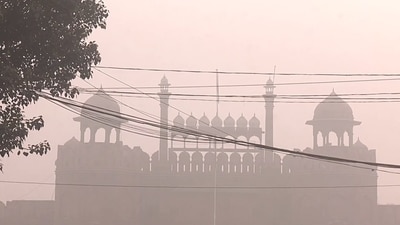
According to the Central Pollution Control Board (CPCB), a dense layer of smog remained in Delhi city for the fourth consecutive day and the air quality index (AQI) was recorded at 406 till 8 am on Saturday.
Also read: High AQI warning: How breathing polluted air can put your brain at serious risk of hemorrhagic stroke
Drone visuals taken at 6.45 am showed the entire area near the All India Institute of Medical Sciences (AIIMS) in Delhi covered in a blanket of smog.
The area near Pragati Maidan is also covered in smog as pollution levels remain high. The AQI of Pragati Maidan and surrounding areas including ITO was recorded at 357 this morning, which has been kept in the ‘very poor’ category.
The scenes in Sarai Kale Khan, shot at 7.15 am, also show the capital surrounded by fog on Saturday morning.
The area around Kalindi Kunj also remained covered with smog and AQI remained in the severe category. Tall buildings in the area were surrounded by fog, reducing visibility to the naked eye.
Also read: Delhi’s toxic air is back: 8 tips to protect the health of your lungs, kids and family amid ‘very poor’ AQI alert
Meanwhile, as pollution levels continue to remain high, toxic foam was seen in parts of the river near Kalindi Kunj and Okhla Barrage mainly due to high phosphate levels from untreated industrial effluents, sewage discharges and detergents.
Delhi residents are raising concerns over air quality levels, with the AQI remaining in the “severe” category in many areas.
Pratik Jain, a local who came for an early morning run at India Gate, spoke to ANI about pollution and AQI levels and said, “While running, we get more tired, we need frequent breaks, cough and The throat also gets sore.” Due to pollution we are not able to run for long.”
The area around India Gate recorded an AQI of 414, which is in the ‘severe’ category as per the Central Pollution Control Board (CPCB).
Similarly, there was fog in Rajghat and surrounding areas also. The drone scenes were shot at 7.30 am.
Also read: Delhi’s AQI deteriorates: Check out long-term risks of toxic air exposure on brain health
Delhi’s worrying air quality:
AQI was 435 in Alipur, 438 in Bawana, 424 in CRRI Mathura Road, 383 in DTU, 415 in Dwarka Sector-8, 397 in ITO, 445 in Jahangirpuri, 351 in Lodhi Road, 423 in Mundka, 449 in Narela. According to SAFAR-India, North Campus at 436, Punjabi Bagh at 425, RK Puram at 401, Shadipur at 454 and Wazipur at 441.
Meanwhile, the Delhi government imposed a ban on plying of BS-III petrol and BS-IV diesel four-wheelers under the Graded Response Action Plan (GRAP-III) in the national capital from Friday to tackle the deteriorating air quality.
According to the government order, violators will face prosecution under Section 194(1) of the Motor Vehicles Act, 1988. 20,000 fine.
This comes after the Commission for Air Quality Management (CAQM) ordered implementation of the Graded Response Action Plan (GRAP-III) in Delhi-NCR from 8 am on Friday to prevent further deterioration in air quality in the National Capital Region. Has come after. The index (AQI) in Delhi deteriorated to the serious category.
GRAP III (Graded Response Action Plan) measures to reduce the impact of air pollution in Delhi NCR include intensifying the frequency of mechanized cleaning of roads, before peak traffic hours, dust suppression on roads and rights of way, including hotspots. Also includes daily water sprinkling. , Proper disposal of dust collected in heavy traffic corridors and designated sites, landfills.
All demolition work, earthworks for digging and filling, including boring and drilling works, and any transportation of demolition waste are banned with the implementation of GRAP III measures to fight air pollution.
The Graded Response Action Plan (GRAP) for the National Capital Region (NCR) has classified Delhi under four different stages of adverse air quality: Stage I – ‘Poor’ (AQI 201-300); Stage II – ‘Very poor’ (AQI 301–400); Stage III – ‘Severe’ (AQI 401–450); and Stage IV – ‘Severe Plus’ (AQI >450).
This year, Phase III has been implemented much later than 2023, when it was activated on November 2. This action plan, effective across the NCR, will complement the already ongoing Phase-I and Phase-II measures.
The 11-point action plan under Phase III includes increased road cleaning, intensified water sprinkling with dust suppression in high-traffic areas and public transport services with differentiated pricing to encourage off-peak travel. Increase is included.
[ad_2]

